
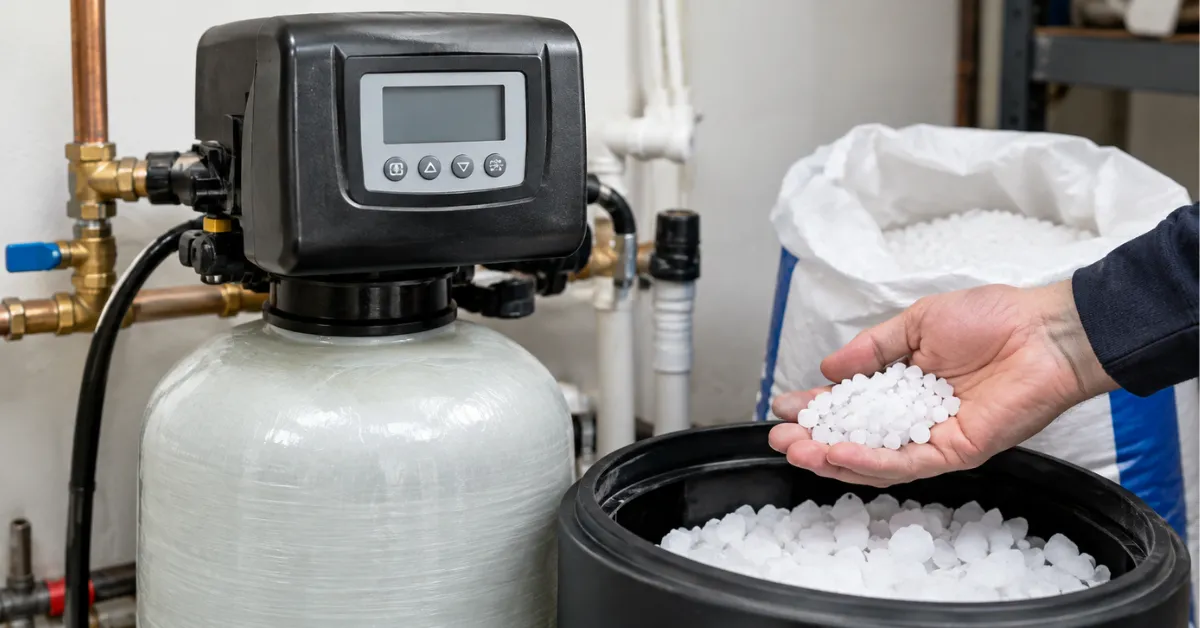
Too much salt in a water softener can cause salt bridges, hardened salt buildup, blocked brine flow, and poor regeneration. Common symptoms include hard water returning, white residue around the brine tank, unusual salt levels, and a system that uses salt without improving water softness. However, a high salt level alone does not always mean something is wrong. The important thing is to check whether the salt is dissolving properly and whether the softener is completing its regeneration cycle.
It’s easy to assume that adding more salt will help a water softener work better. After all, salt is essential for most traditional water softeners to remove calcium and magnesium from household water. But filling the brine tank too often or allowing salt to accumulate can create problems that are difficult to spot at first.
The good news is that many salt-related problems can be identified with a simple inspection. Before buying replacement parts or calling a technician, it helps to understand what normal salt levels look like, which symptoms indicate a problem, and when your water softener may need professional attention.
The Most Common Symptoms of Too Much Salt in a Water Softener
The symptoms of too much salt in a water softener depend on what is happening inside the brine tank. In some cases, excess salt creates a physical blockage. In others, the real problem is that the salt is not dissolving or the system is not regenerating properly.
Look for these warning signs:
- Hard water returning: Soap may lather poorly, and mineral deposits may begin appearing on faucets or shower doors.
- A salt bridge: A hard crust forms above an empty space in the brine tank, making the tank look fuller than it really is.
- Salt that does not seem to disappear: The level remains unchanged over several regeneration cycles, even though the system is using water.
- Salt mush or sludge: A thick layer of salt residue collects at the bottom of the tank and may interfere with normal operation.
- Unexpected salt consumption: The tank empties faster than usual, which may indicate a leak, incorrect settings, or a regeneration problem rather than simply too much salt.
- A regeneration problem: The system may fail to draw brine correctly or may display an error, depending on the model.
One symptom by itself does not confirm that you added too much salt. Water hardness, the system’s settings, household water use, and mechanical faults can produce similar signs.
Can You Put Too Much Salt in a Water Softener?
Yes, you can put too much salt in a water softener, particularly if you fill the brine tank to the top or keep adding salt without checking the existing level.
However, the issue is not always the total amount of salt. Traditional water softeners need enough salt to prepare brine for regeneration, but excess salt can encourage bridging, make inspections difficult, and contribute to maintenance problems.
Most residential systems work well when the salt level stays within the manufacturer’s recommended range. A common rule of thumb is to keep salt above the water level and avoid filling the tank completely. Many manufacturers suggest keeping the tank no more than about one-third to one-half full in normal use, although the correct level depends on the specific model and tank design.
Check your owner’s manual before changing the salt level. Some systems have different brine tank designs, and following the manufacturer’s instructions is more reliable than using a universal measurement.
What Happens When the Brine Tank Is Overfilled?
An overfilled tank can make it harder to see whether the salt is dissolving normally. If moisture and salt form a hard layer, a salt bridge may develop. This creates an empty pocket beneath the crust, so the salt appears plentiful even though the system cannot draw the brine it needs.
As a result, the resin may not regenerate properly. Hardness minerals can then pass through the system, leaving you with hard water despite having plenty of salt in the tank.
Adding even more salt will not solve that problem. The actual issue is the blockage or failure to draw brine, not necessarily a shortage of salt.
How to Tell If Your Water Softener Has a Salt Bridge
A salt bridge is one of the most common problems associated with salt buildup. It forms when salt hardens into a crust inside the brine tank, often because of humidity, temperature changes, or the way salt packs together.
The crust can create a hollow space between the solid salt and the water below. From above, the tank looks full, but the salt is no longer dissolving as expected.
You may have a salt bridge if:
- The salt level has barely changed for several weeks.
- Your water has become hard again.
- The tank looks full, but the system is not using salt.
- You can see a hard, solid layer near the top of the salt bed.
How Should You Check for a Salt Bridge?
First, follow the manufacturer’s instructions for inspecting the brine tank. If the system is safe to access, gently test the salt surface with a suitable blunt plastic tool. Do not use a sharp metal object, and never force a tool deep into the tank because you could damage internal components.
If the surface feels solid but there is an empty space underneath, a salt bridge may be present. Follow the manufacturer’s guidance for breaking it up and cleaning the tank.
If you are unsure, contact a qualified water treatment technician. Avoid reaching into the tank or dismantling components while the system is operating.
Why Is My Water Softener Not Using Salt?
A water softener that stops using salt may have a salt bridge, but there are several other possible causes.
During normal operation, the system periodically draws brine from the tank to regenerate its resin. Salt consumption varies according to water hardness, household usage, the size of the softener, and its programmed regeneration settings.
If the salt level stays the same, start with these checks:
| Possible cause | What you may notice |
| Salt bridge | A hard crust with a hollow space beneath it |
| Blocked brine line | The system does not draw brine properly |
| Incorrect settings | Regeneration occurs too rarely or uses an unsuitable salt dosage |
| Control valve problem | The system fails to complete its normal cycle |
| Low water demand | Salt consumption is lower than expected |
| Incorrect installation | Brine flow or regeneration may not work correctly |
Do not assume that the softener needs more salt just because the level is not dropping. Adding more may hide the underlying problem without fixing it.
Start by checking the salt condition, the displayed settings, and the regeneration history if your model provides one. If the brine tank looks normal but the system still fails to use salt or soften water, professional diagnosis may be necessary.
Does Too Much Salt Make Water Too Salty?
Not necessarily. A large amount of salt sitting in the brine tank does not automatically mean that your household water contains excessive sodium.
In a properly functioning conventional softener, the concentrated brine is used during regeneration and then rinsed from the resin bed before the system returns to service. Salt is not supposed to flow directly into your taps as a result of simply filling the tank.
However, a malfunctioning system can produce unusual water quality, and sodium levels in softened water depend partly on the hardness of the incoming water. If your water tastes unusually salty, do not assume that the brine tank is the only cause.
Check the system’s operation and consult a qualified water treatment professional. If you need to know the actual sodium concentration, a suitable water test is more reliable than taste alone.
People comparing the ongoing expense of different systems may also consider how much does culligan water cost per month when evaluating service fees, salt use, and other ownership costs.
How to Fix Too Much Salt in a Water Softener
If your water softener has too much salt in the brine tank, the right fix depends on whether the tank is simply overfilled, has a salt bridge, contains hardened salt residue, or has a mechanical problem. In many cases, you can correct a salt-related issue by removing some excess salt, carefully clearing a bridge, and following the manufacturer’s cleaning instructions.
Do not immediately empty the entire tank or take apart the control valve. Start with a visual inspection and use the steps below to identify the likely cause.
1. Check the Salt Level Before Adding More
Open the brine tank and inspect how much salt remains. If the tank is filled nearly to the top, stop adding salt until you confirm the recommended level for your model.
A full tank does not automatically mean that the system is damaged. The concern is whether the salt is dissolving correctly and whether the softener can draw brine during regeneration.
If the salt level is already within the manufacturer’s recommended range, adding or removing salt may not solve the problem. Check for a bridge, inspect the displayed error codes, and review the regeneration settings before making further changes.
2. Carefully Break Up a Salt Bridge
If the salt has formed a hard crust, follow your owner’s manual to determine whether it can be cleared without professional help.
For models where the manufacturer permits manual removal, use a blunt plastic tool to gently loosen the crust. Avoid sharp objects, excessive force, and contact with the tank’s internal components.
Once the bridge has been cleared, check whether the salt beneath it is loose or has formed a dense mass. If the bottom of the tank contains substantial hardened salt or sludge, the tank may need cleaning according to the manufacturer’s instructions.
Do not force a tool into an area you cannot see. If the blockage is difficult to reach or you are uncertain how the tank is assembled, ask a technician to inspect it.
3. Remove Excess Salt Only When Necessary
If the tank has been overfilled, you may need to remove some salt to bring it back within the recommended range. The exact method depends on the tank design and the manufacturer’s guidance.
Before removing salt, make sure you know how to put the system into the appropriate service or maintenance mode. Do not disconnect brine tubing, remove the float assembly, or dismantle the control valve just to lower the salt level.
If the tank contains only clean, loose salt, removing a portion may be straightforward. If the salt is wet, compacted, or mixed with sediment, cleaning may be more appropriate than simply scooping some out.
Never pour cleaning chemicals into the brine tank unless the manufacturer specifically instructs you to use a particular product.
4. Check Whether the Softener Regenerates Properly
After addressing a visible salt problem, check the system’s regeneration cycle. A conventional water softener needs to draw brine through its resin bed and rinse the bed before returning to normal operation.
Use the manufacturer’s instructions to review the control settings and regeneration history. Some systems allow a manual regeneration, but you should run one only when the manual says it is appropriate.
If the system still does not draw brine, repeatedly adding salt or triggering regeneration may not help. A blocked injector, obstructed brine line, faulty control valve, or another component problem may require professional diagnosis.
5. Test the Water After the Repair
Once the system has completed the appropriate regeneration and returned to service, check whether it is softening water again.
You can use a water hardness test kit to compare the incoming water with the treated water. Soap performance and mineral deposits may offer clues, but they are not as reliable as testing.
If the treated water remains hard, the cause may be unrelated to excess salt. The softener could be incorrectly sized, programmed improperly, overdue for maintenance, or experiencing a resin or control-valve problem.
How to Clean a Water Softener Brine Tank
Cleaning may be necessary when the tank contains a large amount of hardened salt, sediment, or accumulated residue. Not every salt bridge requires a full tank cleaning, so inspect the condition first.
Follow the owner’s manual because some brine tank designs have removable parts, safety floats, or specific cleaning requirements.
A general maintenance process may include the following steps:
- Read the manufacturer’s instructions. Confirm whether the brine tank can be cleaned by the homeowner and identify any required precautions.
- Put the system into the recommended maintenance state. Follow the manual before removing salt or accessing the tank.
- Remove salt only as directed. If cleaning requires emptying the tank, use an appropriate method to remove the salt without damaging the tank or nearby plumbing.
- Inspect for residue or damage. Look for hardened salt, sediment, unusual discoloration, or damaged components.
- Clean the tank according to the manual. Use only approved cleaning methods and products. Do not mix cleaning chemicals.
- Reassemble and refill correctly. Restore the components as instructed and use the type of salt recommended for the system.
- Check operation. Confirm that the system returns to service and completes its next required regeneration.
Do not remove or reposition the safety float assembly unless the manufacturer explains how to do so. An incorrectly reassembled float or brine component can interfere with normal operation.
If the tank has persistent sludge, unexplained standing water, a damaged float, or repeated brine-draw failures, professional service is a sensible next step.
How Much Salt Should Be in a Water Softener?
There is no single salt level that suits every water softener. The correct amount depends on the tank design, the manufacturer’s recommendations, the system’s capacity, and how much treated water your household uses.
As a general maintenance habit, keep enough salt available for normal regeneration without routinely filling the tank to its maximum capacity. Many homeowners inspect the tank every few weeks and add salt when the level falls, but the ideal inspection schedule depends on consumption and the system.
| What you observe | What to do |
| Salt level is within the manual’s recommended range | Continue normal monitoring |
| Tank is almost full | Stop adding salt and check the manufacturer’s recommended maximum |
| Salt level does not change for a long time | Check for a bridge and verify regeneration |
| Salt is disappearing much faster than usual | Investigate settings, water use, leaks, or equipment problems |
| Hard water returns despite plenty of salt | Check regeneration and consider professional diagnosis |
| Tank contains hardened residue or persistent sludge | Follow the manufacturer’s cleaning procedure |
Salt consumption is not a reliable measure of water softness by itself. A household using more water or dealing with harder incoming water may use more salt than a household with lower demand.
Does the Type of Water Softener Salt Matter?
Yes. Salt products vary in purity, form, and suitability for different systems. The best option is the type specifically recommended by your softener’s manufacturer.
Common options include:
- Salt pellets: Often used in residential systems and convenient for routine refilling.
- Solar salt: Produced by evaporating seawater or brine and sold in different forms.
- Rock salt: May contain more insoluble impurities than higher-purity alternatives, potentially increasing the need for cleaning in some systems.
Avoid choosing salt solely because it is cheaper. A product that leaves more residue may increase maintenance needs, depending on the water softener and the product’s composition.
Also, do not use ice-melt products or ordinary deicing salt in a water softener. They are designed for a different purpose and may contain ingredients unsuitable for water treatment.
If you are unsure which salt to buy, check the model’s manual or ask the manufacturer. Using the recommended salt is generally a better starting point than changing products to solve a mechanical issue.
What If the Water Softener Still Uses Too Much Salt?
A softener that consumes salt unusually quickly may not actually have too much salt in the tank. Instead, it may be regenerating too often, using an unsuitable salt dosage, or responding to a problem elsewhere in the system.
Start by checking these possible causes.
Regeneration Happens Too Frequently
Some softeners regenerate based on a schedule, while others use water consumption or a combination of settings. If the schedule or hardness setting is incorrect, the unit may regenerate more often than necessary.
Review the programmed settings using the manufacturer’s instructions. Do not reduce the salt dosage arbitrarily because an insufficient amount of brine can leave the resin inadequately regenerated.
Incoming Water Hardness Has Changed
A change in the water supply can affect how much work the softener must do. For example, a household that switches water sources may experience a different hardness level.
A hardness test can help establish whether the existing settings are suitable. If the incoming water is harder than the system was configured for, a qualified technician or the manufacturer may help determine the appropriate adjustment.
The System Has a Mechanical Problem
A leaking valve, control issue, or brine system fault can cause abnormal salt consumption or poor performance. These problems are not necessarily solved by cleaning the tank.
If the system’s salt use changes suddenly, treated water becomes hard, or error messages appear repeatedly, have the unit checked rather than continuing to add salt.
The Resin May Need Attention
The resin inside a conventional softener exchanges hardness minerals for sodium or potassium ions. Over time, resin performance can decline because of age, fouling, damage, or unsuitable operating conditions.
However, a resin problem should not be diagnosed from salt consumption alone. If the resin needs service, understanding the potential water softener resin replacement cost can help you compare repair with replacement, but testing and diagnosis should come first.
Can Too Much Salt Damage a Water Softener?
Simply having a high level of clean salt in the brine tank does not automatically damage a water softener. The bigger concerns are salt bridging, poor brine flow, accumulated residue, incorrect operation, and problems that remain untreated.
Repeatedly overfilling the tank can also make it harder to inspect the salt bed and notice whether the salt is being used normally. A system that cannot draw brine correctly may fail to regenerate its resin, allowing hardness minerals to pass through the unit.
The control valve, injector, brine line, and float assembly may need attention if the system repeatedly fails to regenerate. These are equipment-specific issues, so avoid dismantling components without the proper instructions.
Routine checks, correct salt, and proper settings are usually more useful than adding extra salt in an attempt to improve performance.
Should You Repair or Replace a Water Softener With Salt Problems?
A salt bridge or an overfilled tank is usually a maintenance issue, not a reason to replace the entire system. Start with the simplest explanation and consider replacement only after identifying the actual fault.
Repair may be reasonable when the tank is in good condition, the control valve works correctly, and the problem is limited to salt buildup or a serviceable component.
Replacement may deserve consideration when the system has repeated failures, major component damage, inadequate capacity, or repair costs that are difficult to justify for an older unit.
If you are comparing different brands, look beyond the initial purchase price. For example, the kinetico water softener cost and ecowater water softener price may include different equipment configurations, installation arrangements, and service options. Ask for an itemized estimate so you can compare what is actually included.
Renting is another option for households that prefer service arrangements over owning the equipment outright. Before choosing that route, compare the water softener rental cost per month with the total long-term cost of ownership, including salt, maintenance, and repairs.
Installation can also affect the overall budget. If a new system is being considered, local plumbing conditions and labor rates may change the final amount. Homeowners in Texas, for instance, can research water softener installation cost san antonio to understand the factors that influence a local installation estimate.
These costs are worth comparing only after you establish whether your existing unit can be restored to normal operation.
Does a Salt-Free Water Conditioner Avoid These Problems?
Salt-free water conditioners do not use a conventional brine tank for salt-based regeneration, so they do not develop the same salt bridges or brine-draw problems.
However, salt-free systems are not identical to traditional water softeners. Many condition water to reduce mineral scale formation rather than removing calcium and magnesium through ion exchange. Their results and suitability depend on the technology, water chemistry, and manufacturer’s claims.
If your main concern is reducing maintenance associated with salt, it may be useful to learn if a water softener removes minerals and how that differs from a salt-free conditioner. You can then compare the upfront cost of a salt-free water softener system with the long-term costs of a conventional unit.
Do not assume that a salt-free system will provide the same results as a traditional softener. Choose based on your water test, household needs, and the specific treatment method.
Frequently Asked Questions
Should I remove salt if my water softener tank is too full?
Not automatically. Check the manufacturer’s recommended salt level first. If the tank is overfilled, remove some salt only using the method recommended for your model. If the real problem is a salt bridge or a failed regeneration cycle, simply removing salt may not solve it.
How often should I add salt to my water softener?
There is no universal schedule. Salt use depends on incoming water hardness, household water consumption, softener capacity, and regeneration settings. Inspect the brine tank regularly and add salt according to the manufacturer’s instructions rather than topping it up every few days.
Can I use my water softener if there is a salt bridge?
A salt bridge can prevent the system from drawing the brine required for regeneration. If the system is not regenerating correctly, water hardness may return. Follow the manufacturer’s guidance to clear the bridge and check operation before assuming the issue is resolved.
Why is my water still hard when the salt tank is full?
The system may have a salt bridge, blocked brine line, incorrect settings, or a control-valve problem. A full tank only shows that salt is present. It does not prove that the softener is drawing brine and regenerating properly.
Can too much salt make tap water taste salty?
A high level of salt in the brine tank should not normally make household water taste salty. If you notice an unusual salty taste, have the system and water checked. A water test is more reliable than taste for determining water quality.
Should I use a regeneration cycle after fixing a salt bridge?
That depends on your softener’s instructions and whether it has completed regeneration properly. Some manufacturers provide a manual regeneration procedure. Follow the model-specific guidance rather than repeatedly starting cycles, which may waste water and salt without addressing an underlying fault.
Is salt sludge in the bottom of the tank normal?
A small amount of residue can occur in some systems, but substantial sludge or hardened material may interfere with operation. Follow the manufacturer’s cleaning instructions, use the recommended salt, and seek professional help if the buildup keeps returning.
Can I prevent salt bridges by using less salt?
Keeping the salt within the recommended range and avoiding unnecessary overfilling may help, but the amount of salt is not the only factor. Humidity, temperature changes, salt quality, and tank conditions can also contribute. Regular inspection is more useful than maintaining an arbitrary low salt level.
Conclusion
Too much salt in a water softener can be a sign of overfilling, but the more important question is whether the salt is dissolving and the system is regenerating correctly. A salt bridge, hardened residue, blocked brine flow, or incorrect settings can all cause problems even when the tank looks full.
Inspect the tank, follow the manufacturer’s cleaning and maintenance instructions, and test the treated water after the issue has been addressed. If the softener continues to use salt unusually quickly, fails to draw brine, or produces hard water despite correct maintenance, arrange a professional inspection.
The best way to prevent recurring salt problems is to use the recommended salt, avoid unnecessary top-ups, monitor the system’s performance, and investigate changes in salt consumption instead of assuming that more salt will make the water softer.